Louisiana Swamps: A Complete Guide to the Cypress Wetlands
Louisiana has more freshwater swamp than any other state in the country, and most visitors here see exactly one of them, on a 90-minute tour, and leave thinking they understand the place. The real story is bigger and more interesting. This is the long version, written the way we’d tell it to a friend who asked.
What a swamp actually is
A swamp is a freshwater wetland forested with trees, where the soil is saturated for most or all of the year. That’s the technical definition. The everyday version: a swamp is what happens when a river slows down enough that trees can grow in the floodplain.
It’s worth being precise here because Louisiana has three different kinds of wetland and they get confused constantly:
- Swamp. Forested freshwater wetland. Cypress, tupelo, water oak. What most people picture when they think “Louisiana swamp.”
- Marsh. Treeless wetland. Freshwater, brackish, or saltwater. Grasses, sedges, no overstory. The big stretches between New Orleans and the Gulf are mostly marsh.
- Bayou. A slow-moving body of water. Can run through a swamp, a marsh, or neither. “Bayou” describes the water; “swamp” describes the land.
So Manchac is a swamp with bayous running through it. The Wetland Triangle east of New Orleans is part swamp (Bayou Bienvenue’s ghost forest) and part open water now. The land south of the city toward the Gulf is mostly marsh, not swamp.
Where Louisiana’s swamps actually are
The state has roughly 600,000 acres of cypress-tupelo swamp left, down from over a million in the 1800s. Most of it sits in two regions:
The Atchafalaya Basin. The largest wetland in the lower 48 states, covering about 1.4 million acres in south-central Louisiana between Baton Rouge and Lafayette. It’s the most ecologically intact swamp system in the country, and it’s where the Mississippi River would actually go if humans hadn’t engineered the levees that keep it on its current course. Roughly two-thirds of the Basin is bottomland hardwood and cypress-tupelo swamp.
The southeast Louisiana lowlands. A patchwork of swamps and bayous running roughly from Baton Rouge through New Orleans east to the Mississippi state line. This includes Manchac, Maurepas, the Wetland Triangle, Honey Island, and the Pearl River drainage. Smaller in total area than the Atchafalaya, but more accessible to most New Orleans visitors.
Beyond those two regions, you have scattered cypress swamps in the river floodplains across the rest of the state, plus the dwindling coastal swamps that are slowly being converted to marsh by saltwater intrusion.
The major Louisiana swamps you can visit
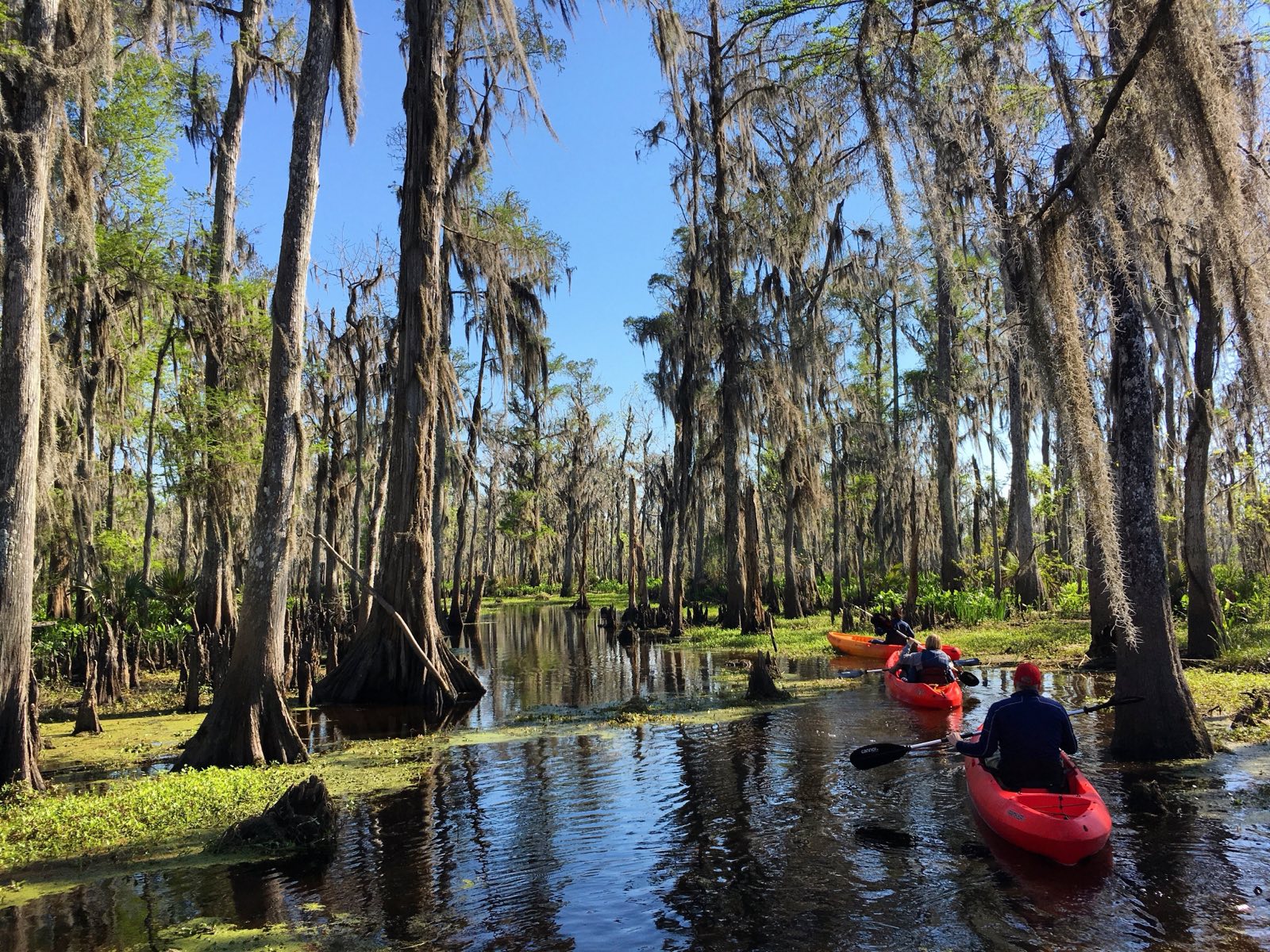
Manchac Swamp. 30 minutes northwest of the French Quarter, between Lakes Pontchartrain and Maurepas. The second-largest bald cypress swamp in the country and the most accessible mature cypress canopy in the region. Most New Orleans swamp tours operate here. Our Manchac visitor guide goes deeper.
Maurepas Swamp Wildlife Management Area. Manchac is technically part of this larger WMA, which extends west and south. State-protected, mostly inaccessible without a boat, with some of the most intact cypress in the state.
Honey Island Swamp. About an hour from New Orleans, off the Pearl River near the Mississippi state line. Bigger and wilder than Manchac, but harder to access and more variable depending on water level. Worth a return trip after Manchac, not a first one.
Bayou Bienvenue. Five minutes from the French Quarter, in the Lower 9th Ward. Mostly a “ghost forest” of standing dead cypress killed by saltwater intrusion. The most powerful trip we run for guests who want to understand what’s happening to the Louisiana coast. The longer story is here.
Atchafalaya Basin. Roughly 90 minutes west of New Orleans. Vast, beautiful, and best experienced on a multi-day trip with a guide who knows the navigation. Not a half-day visit from the city, but the most ecologically significant wetland in North America if you have time.
Jean Lafitte National Historical Park. 30 minutes south of New Orleans. A unit of the National Park Service with boardwalks through cypress-tupelo swamp at the Barataria Preserve. Free, walkable, and great for visitors who don’t want to get on the water but still want to see the swamp.
Cypress and tupelo: the trees that define the swamp
Two species dominate the Louisiana cypress swamp: bald cypress (Taxodium distichum) and water tupelo (Nyssa aquatica). Both are flood-adapted, both can live for centuries, and both define what a Louisiana swamp looks and sounds like.
Bald cypress. Conifer, deciduous, distinctive feathery needles that turn rust orange in the fall before dropping. Old-growth cypress can live well over 1,000 years. The strange knobby protrusions around the base, called knees, are one of the iconic features of the swamp. Botanists still argue about what knees actually do (oxygen exchange? structural anchoring? both? neither?). What’s clear is they grow up to roughly the high-water mark, and they’re indestructible enough that you can see Civil War-era knees still standing.
Water tupelo. Hardwood, broad-leaved, often growing alongside cypress in the wettest parts of the swamp. The fruit is a primary food source for migratory birds in late summer and fall.
Spanish moss. The gray-green plant draped over almost every cypress branch isn’t moss at all. It’s Tillandsia usneoides, an air plant in the bromeliad family, related to the pineapple. It doesn’t harm the tree. It pulls moisture and nutrients from the air. It only grows in clean air, which is why you don’t see it in cities, and why you do see it everywhere at Manchac.
What lives in the swamp
Louisiana cypress swamps support some of the densest wildlife populations in North America. The full list runs to hundreds of species. The headline residents: American alligators, herons and egrets in nearly every species you can name, prothonotary warblers, anhingas, bald eagles in winter, river otters, occasional black bear in the deeper parts of the Atchafalaya, water snakes (mostly non-venomous), red-eared slider turtles, largemouth bass, catfish, and plenty more. Our running list of swamp birds covers the avian side.
People come to Louisiana swamps thinking “alligators.” There are alligators. They’re worth the trip. But most experienced naturalists will tell you the wading birds are the more sustained spectacle, and the swamp’s quiet hours, the early morning and late afternoon, are when the place is loudest with bird calls. If you want the alligator-specific knowledge, that’s the post.
The crisis: what Louisiana is losing
Louisiana loses about a football field of land every 100 minutes. That’s the number that gets cited in news articles and scientific reports, and it’s accurate to within reason. The slower truth: the loss is concentrated in the coastal parishes south and east of New Orleans. By the time today’s first-graders are old enough to vote, the Louisiana coastline they inherit will be tens of thousands of acres smaller than the one on the map in their classrooms.
Three forces are driving the loss:
- Subsidence. The Mississippi delta is naturally sinking, a process that’s been happening since the river first started building delta land. Oil and gas extraction in the 20th century accelerated it.
- Sea level rise. Climate change is raising Gulf water levels, and the Louisiana coast is one of the most vulnerable shorelines in the country.
- Levee-induced sediment starvation. The Mississippi River levee system, built for flood control and shipping, prevents the river from depositing fresh sediment in the delta. Without that resupply, the wetlands erode faster than they can rebuild.
The cypress swamps specifically are threatened by saltwater intrusion. As marshes south of the swamps convert to open water, salt water pushes inland. Cypress can tolerate brackish water for short stretches but not sustained salt exposure. The maps of dying cypress in the southeast lowlands track closely with the maps of wetland salinity over the past 50 years.
What’s being done about it
The most ambitious wetland restoration in U.S. history is happening right now in Louisiana. The Coastal Wetlands Planning, Protection and Restoration Act has funded over 200 projects since 1990. The Mid-Barataria Sediment Diversion is designed to reconnect the river to the delta and start rebuilding wetlands south of New Orleans.
At the local scale, organizations like Sankofa Community Development Corporation in the Lower 9th Ward have been replanting cypress in Bayou Bienvenue since 2008, with over 100,000 trees in the ground. We’re a partner on this work, and a portion of every tour booking goes directly to Sankofa’s cypress replanting program.
None of it reverses the loss in our lifetimes. All of it slows the loss for the next generation.
How to actually visit a Louisiana swamp
You have four real options.
Walking. Boardwalks at Jean Lafitte, the Manchac Swamp boardwalk near Frenier, and the Atchafalaya Welcome Center give you swamp access without a boat. Three free swamp walks in and around New Orleans covers the best of these.
Airboat or pontoon tour. Faster, bigger groups, more distance covered. The trade-off is noise and a heavier wildlife footprint. Some operators bait alligators, which is illegal in most areas and ecologically destructive. Our airboat vs. kayak comparison covers what to look for.
Kayak tour. Closer to the water, no motor, smaller groups, wildlife behaving naturally. Slower, gets you wet, requires some light effort, but the quality of the experience is hard to match. This is what we do.
Self-guided rental. If you have basic kayak experience and your own transportation, you can rent and paddle on your own from public launch points. Here’s our rental setup.
For most first-time visitors, the small-group kayak tour at Manchac is the right answer. If you want the full how-to-pick guide, we wrote that too.
Frequently asked questions
What is the largest swamp in Louisiana? The Atchafalaya Basin, covering about 1.4 million acres in south-central Louisiana, is the largest wetland in the lower 48 states. The closer-to-New-Orleans alternative is Maurepas Swamp Wildlife Management Area, which includes Manchac and is the second-largest bald cypress swamp in the country.
What’s the difference between a swamp, a marsh, and a bayou? A swamp is a forested freshwater wetland with trees like cypress and tupelo. A marsh is a treeless wetland dominated by grasses and sedges, and can be freshwater, brackish, or saltwater. A bayou is a slow-moving body of water that can run through a swamp, a marsh, or neither.
Is the Louisiana swamp dying? Parts of it, yes. Coastal cypress swamps closer to the Gulf are being lost to saltwater intrusion driven by subsidence, sea level rise, and the engineered separation of the Mississippi River from its delta. The Atchafalaya Basin and the upland portions of Manchac and Maurepas are relatively healthy.
What’s the best Louisiana swamp to visit from New Orleans? Manchac, for most visitors. It’s 30 minutes from the French Quarter, has the densest accessible cypress canopy, and supports consistent wildlife year-round. Bayou Bienvenue is a more powerful educational trip for guests with conservation interest.
If you’ve made it this far, you’re already more informed about Louisiana swamps than 99 percent of visitors who book a tour. The next step is the water. Our standard Manchac Mystic Kayak Tour runs five times a day, 12 people max, no motor, the same cypress canopy our guides have been paddling since 2013. The swamp doesn’t perform for you. You show up quiet, and it shows you what it wants to.