The Real Guide to Swamp Tours Near New Orleans (How to Pick One)
There are about a dozen ways to see a Louisiana swamp from New Orleans. Most of them involve a loud engine and a guy throwing marshmallows at an alligator. We don’t run that kind of tour, and this is a guide to telling the difference before you book.
We’ve been on the water at Manchac since 2013. We’ve taken close to 5,000 guests out, almost all of them first-time kayakers. The most common booking question we get isn’t about price or duration. It’s some version of “what’s the difference between all these tours, and which one is right for us?” This is the long answer.
The three swamps you can actually visit from New Orleans
People search “swamp tours New Orleans” thinking they’re picking between operators. They’re really picking between three different swamps, each with its own character.
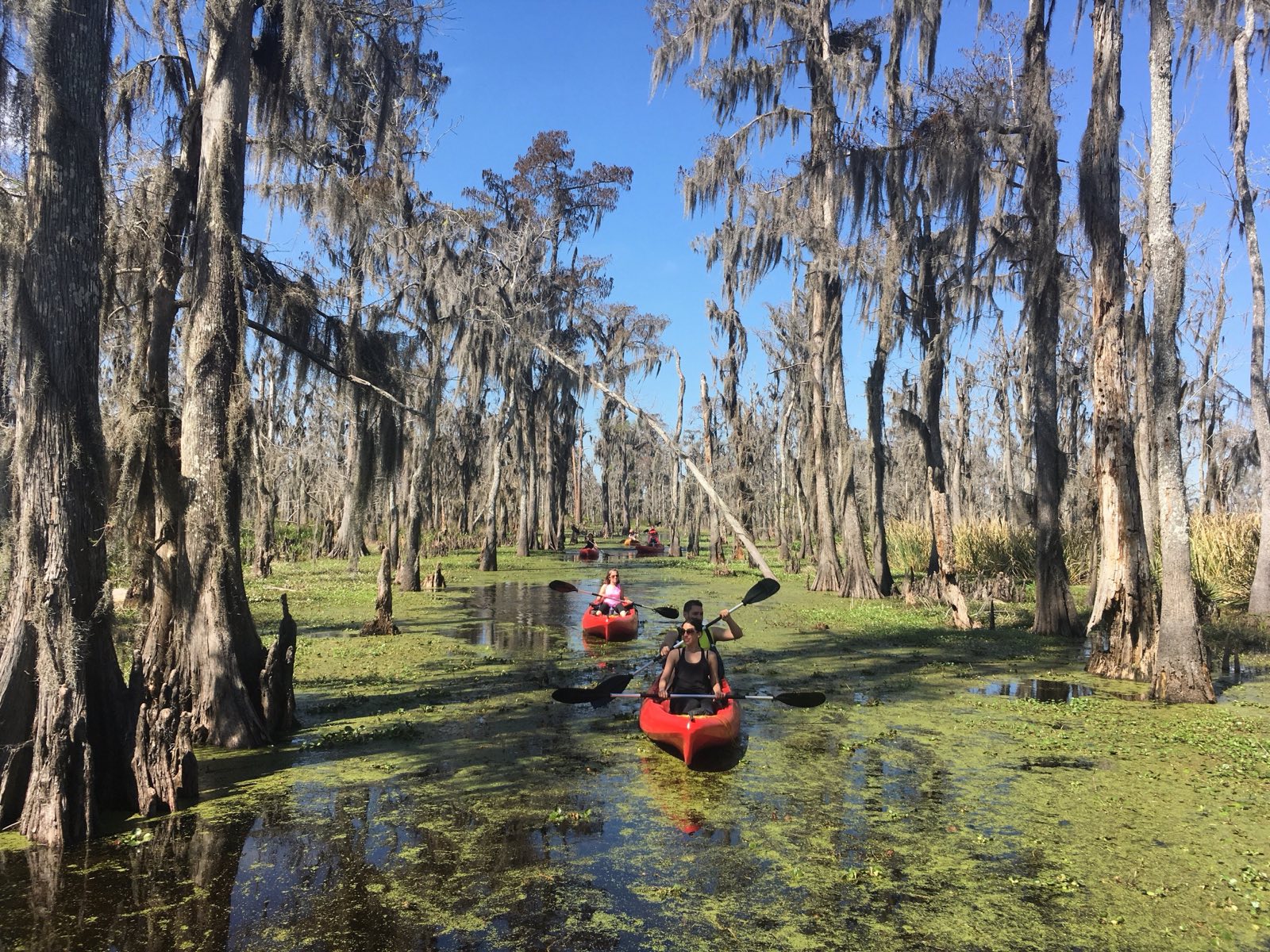
Manchac. 30 minutes northwest of the French Quarter, off Highway 51 near LaPlace. Manchac is the second-largest bald cypress swamp in the United States and one of the most ecologically intact wetlands in the region. It’s our home water. Tannin-stained, mostly shallow, lined with cypress and tupelo, and protected as part of the Maurepas Swamp Wildlife Management Area. Most visitors leave Manchac saying it’s the most beautiful place they didn’t know existed.
Honey Island. Closer to the Mississippi state line, off the Pearl River. Bigger, wilder, more bald cypress and water tupelo than Manchac, but harder to access and the wildlife sightings depend more on water level. We’ve run trips there in past seasons. It’s a real swamp. It’s also a longer drive, and the experience is less consistent than Manchac.
Bayou Bienvenue and the urban bayous. Five minutes from the Lower 9th Ward. Most people don’t realize there’s a bayou this close to the French Quarter, and that part of it is a “ghost forest,” tens of thousands of acres of cypress that died after Hurricane Katrina, with restoration efforts still underway. We launch educational tours here too, in partnership with Sankofa CDC. It’s a different kind of trip. Less postcard, more story.
If your goal is “see a beautiful Louisiana cypress swamp and look for alligators,” Manchac is the right answer 90% of the time. The rest of this guide assumes that’s why you’re here.
The actual choice: motor or paddle
Once you’ve picked Manchac, the next decision is the format. There are two real options.
Airboat or pontoon tour
Airboats are the loud, flat-bottomed boats with the giant fan on the back, the ones that show up in every Cajun postcard. Pontoon tours run quieter motors but cover more water. Both formats put you in a group of 20 to 30 people, run for about 90 minutes, and do most of the work for you. They cover more distance than a kayak can, so you see more shoreline. They’re also fast, and that means engines. Engines mean noise, wake, and a lot of wildlife getting out of the way before you arrive.
The thing nobody mentions on the booking page: many motor-tour operators bait alligators with marshmallows or hot dogs to guarantee a sighting. It works. Gators come up to the boat, the tourists get their photo, the operator gets a tip. It’s also illegal under Louisiana Department of Wildlife and Fisheries rules in most areas, and even where it isn’t, it’s bad for the gators. Habituated alligators lose fear of humans. They get relocated. Sometimes they get euthanized. The tourist gets a great photo. The animal pays for it.
Some motor-tour operators don’t bait. We won’t name them, but they exist, and they’re worth supporting. Read the recent reviews. If the wildlife sightings sound suspiciously perfect every single trip, you have your answer.
Kayak tour
A kayak puts you 18 inches off the water with no motor running. The wildlife behaves differently because nothing tells it you’re there. You glide past nesting herons, you watch turtles drop off cypress knees as you approach instead of hearing them flee from a wake, and the alligators you see are the ones that wanted to be where they are, not the ones that came to a boat for food.
The trade-offs are real. You cover less distance. You get a workout (a light one, but it’s a workout). You depend on the weather more than a motorboat does. Group size is smaller, usually capped at 12, sometimes 6. There’s no bathroom. You will probably get a little wet.
For most visitors who want the “real” swamp experience, the kayak version is the better tour. It’s also why this site exists. We run it five times a day at Manchac, year-round.
See the Manchac Mystic Kayak Tour for the standard version, or read our full airboat vs. kayak comparison for a deeper breakdown of the two formats.
How to pick a swamp tour, regardless of operator
If you’re choosing between operators, ours included, here’s a checklist that works as a fairness filter.
- Group size. Anything over 12 starts feeling like a herd. Anything over 20 is a bus tour with a swamp behind it. Smaller is almost always better, both for wildlife and for actually getting your guide’s attention.
- Guide background. Ask, on the booking page or in the FAQ, who guides the tours. “Local guide” tells you nothing. “Naturalist,” “biologist,” “long-time guide who knows the ecology” is a real signal. Look for guides who can name three species you’ll see and tell you what they do here.
- The wildlife claim. Operators who promise alligator sightings on every tour are either baiting or lying. We use the phrase “common, not guaranteed,” and it’s not weasel language. April through October, gators are common. December and January, they’re hibernating in mud and you might not see one. That’s nature, not bad service.
- Safety equipment. USCG Type III life jackets are the actual standard. CPR-certified guides should be the floor, not a luxury. Our track record after 12 seasons is around 5,000 guests and zero guest injuries, and we don’t say that as marketing. We say it because it’s the only metric that matters.
- The shuttle question. Some operators include hotel pickup, some charge for it, some require you to drive yourself to the launch. Read the fine print. A $59 tour with a $25 mandatory shuttle is a $84 tour. Our shuttle from the French Quarter is $25, and it’s optional if you have a car.
- The reviews you trust. Skip the five-star reviews that read like ad copy. Read the three-star reviews. They tell you what actually happens on a bad day, who handles cancellations well, and whose guide was reading from a card. Across the New Orleans operators, you’ll see the same patterns repeat.
Cost: what a swamp tour actually costs in 2026
Pricing in this industry is more variable than it looks. Here’s the rough range, before any tip.
- Group airboat or pontoon tour: $30 to $65 per person, 90 minutes, plus shuttle if needed.
- Kayak swamp tour (group, 12 max): $59 to $79 per person, 2 to 2.5 hours.
- Extended kayak tour (4 hours): $130 per person.
- Plantation and swamp combo: $195 per person, full day.
- Private kayak tour (1 to 3 people): around $450 flat.
Our standard Manchac Mystic Kayak Tour is $65 per person, 2 to 2.5 hours, kayak and PFD and paddle and lesson included, group capped at 12. Add $25 if you need shuttle pickup from the French Quarter.
When to go (this matters more than people think)
The single biggest variable in your tour quality is when you go.
Time of year. March through October is peak. Water is warm, gators are active, wildflowers are out, birds are nesting and migrating. December through February is the off-season. Gators hibernate. The swamp goes quiet. It’s still beautiful, but the wildlife is mostly hidden. We run tours year-round, and the winter tours are gorgeous in their own way (no mosquitos, low water, you can see the structure of the swamp better) but you should know what you’re booking.
Time of day. Early morning and late afternoon are best for wildlife. Gators are most active when it’s warm but not blistering, so an 8 AM or 4:30 PM start usually beats noon. We have a longer post on this: the best time of day to go on a swamp tour in New Orleans.
Weather. Light rain is fine. Lightning isn’t. We cancel for thunderstorms (full refund), and we recommend a windbreaker even in summer because the swamp can be 10 degrees cooler under the cypress canopy.
Two things to read before you book
If you’re going to be on the water in Louisiana, two pieces of context make the trip ten times more interesting:
- The difference between alligators and crocodiles, including which one you’ll see in Louisiana (alligators, never crocodiles) and how to tell at a glance.
- Three free swamp walks in and around New Orleans, in case you want a no-cost preview before committing to a full tour.
Frequently asked questions
What is the best swamp tour near New Orleans? The most consistent answer for first-time visitors is a small-group kayak tour at Manchac, the second-largest bald cypress swamp in the United States. It’s 30 minutes from the French Quarter and offers the closest, quietest wildlife encounters because the lack of a motor means animals behave naturally. Airboat and pontoon tours cover more water but at the cost of noise, wake, and group size.
Is Manchac better than Honey Island for a swamp tour? For most visitors, yes. Manchac is closer to New Orleans, more accessible, and has more consistent wildlife sightings throughout the year. Honey Island is bigger and wilder but the experience varies more with water levels and season, and the drive is longer.
Are there alligators on a New Orleans swamp tour? April through October, alligator sightings are common but not guaranteed. December through February, gators hibernate in the mud and sightings drop to nearly zero. Any operator that promises alligators on every tour is either baiting them or stretching the truth. We use the phrase “common, not guaranteed” because it’s the honest version.
Do I need experience to do a kayak swamp tour? No. About 90 percent of our guests have never been in a kayak. We do a 10-minute lesson before you push off, the water at Manchac is calm and shallow with no current, and the boats we use are very stable. If you can sit upright and follow basic instructions, you can do this tour.
If this guide saved you from a marshmallow tour, our work here is done. If you want the version where you sit 18 inches off black water in a quiet boat and watch a heron land 30 feet from you, we have a tour for that. Five times a day, 12 people max, the same swamp our guides have been paddling since 2013.