Bayou Bienvenue: The Vanishing Swamp in the Lower 9th Ward
There used to be a 30,000-acre cypress forest five minutes from the French Quarter. By the time Katrina hit in 2005, almost all of it was gone. What’s left is a stretch of standing dead trees you can see from the Lower 9th Ward levee, and we paddle here on purpose. This is why.
Where Bayou Bienvenue is
Bayou Bienvenue sits in what’s called the Wetland Triangle, east of New Orleans, between the city, the Mississippi River Gulf Outlet canal, and Lake Borgne. From the levee at Caffin Avenue you can see the whole story written in trees: bleached gray trunks standing in shallow water, no canopy, no understory, the kind of silence that means nothing’s nesting here.
It’s a 15-minute drive from the French Quarter. Most New Orleans visitors never come to the Lower 9th Ward, and the ones who do mostly look at the houses, not the bayou behind them. The bayou is where the longer story lives.
What happened to the swamp
The cypress didn’t die in one storm. It died in increments, starting in 1965, when the Army Corps of Engineers finished cutting the Mississippi River Gulf Outlet, known locally as MR-GO. The canal opened a 76-mile shortcut for shipping between the Gulf of Mexico and the Industrial Canal at the city’s east edge. On paper it was efficient. In practice, it funneled saltwater inland on every tide.
Cypress and tupelo, the two dominant trees of the Louisiana freshwater swamp, can’t tolerate sustained brackish water. Over the next four decades, the trees of the Wetland Triangle died standing. By the early 2000s, what had been a working swamp protecting the city’s eastern flank was a ghost forest. The trees were still there. The swamp wasn’t.
Hurricane Katrina, in 2005, finished what MR-GO started. The storm surge came up the canal exactly the way wetland scientists had warned for years. The Lower 9th Ward levee failure that flooded the neighborhood was downstream of all of this. The swamp that should have absorbed some of that surge had been gone for 30 years.
MR-GO was officially closed and partially filled in 2009, after a federal judge ruled that the Corps was responsible for the wetland destruction that amplified Katrina’s damage. Closing the canal didn’t bring the trees back.
Why we paddle here
We don’t run Bayou Bienvenue tours because they’re beautiful. We run them because they’re true.
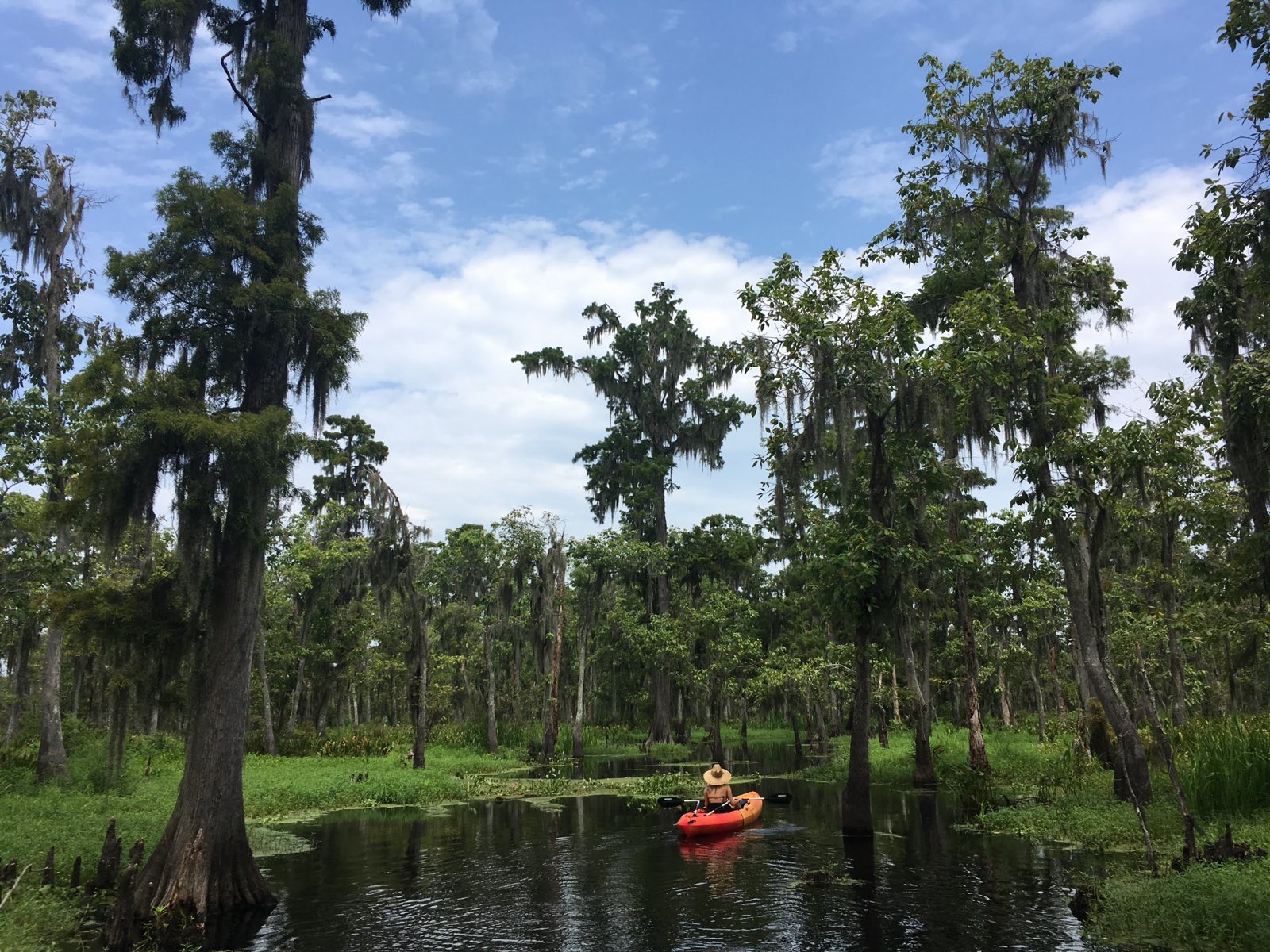
Manchac is what a working Louisiana swamp looks like. Bayou Bienvenue is what happens to a swamp when the math goes wrong. Most of our guests have never thought hard about coastal land loss until they’re sitting in a kayak in the middle of a stand of dead cypress, with the New Orleans skyline visible across the water to the west. It changes the conversation.
This is also part of how we got into the conservation work in the first place. Watching a swamp disappear in real time, on tours we still run, makes it impossible to treat it as somebody else’s problem.
Sankofa and the cypress replanting
Bayou Bienvenue isn’t only a graveyard. It’s also one of the most active wetland restoration sites in the region. We partner with Sankofa Community Development Corporation, the Lower 9th Ward non-profit that’s been planting cypress here since 2008. They’ve put in well over 100,000 trees. Not all of them survive. The ones that do are the start of a slow rebuild that nobody alive today will see finished.
On our educational paddles we go past the Sankofa cypress plots, and you can see the contrast: spindly six-foot saplings rooted in soft mud where there used to be a 100-foot canopy. The new trees won’t replace what was lost in our lifetimes. But they’re a vote that the place is worth replanting.
If you want to support the work without paddling out yourself, you can adopt a cypress through Sankofa or through our cypress restoration program. Every guest who books a tour pays into a small per-trip cypress planting fund that goes directly to Sankofa.
What you’ll actually see on the water
It’s not all dead trees. Bayou Bienvenue is alive, just differently than Manchac.
- Wading birds. Great egrets, snowy egrets, herons. They like the open water and the access to fish from the bayou’s connection to Lake Borgne.
- Alligators. Yes, even here. Smaller populations than Manchac, but present, and unbothered by kayaks.
- Cypress saplings. The Sankofa plots, planted in stages since 2008. The healthiest are now 15 to 20 feet tall.
- Brown pelicans. Sometimes, especially closer to the lake.
- The skyline. The view of New Orleans from the middle of the bayou is one of the more disorienting urban-meets-wild moments you can have on a kayak in this country.
What you won’t see: the dense cypress canopy, the prothonotary warblers, the Manchac alligator density. This is a different trip. Book it for what it is, not for what Manchac is.
How to actually visit
Our Bayou Bienvenue paddles run on request, in partnership with Sankofa CDC. They’re shorter than the Manchac tour, less wildlife-focused, and the launch is from inside the Lower 9th Ward. Bring water, bring sun protection, bring a notebook if you’re a journalist or a student. We’ll talk through the history while we paddle, and your guide will know more about the science than the average tour guide does, because we’ve been working with the wetland researchers and Sankofa volunteers since the partnership started.
If you’d rather not paddle, the Sankofa Wetland Park has a public viewing platform off Caffin Avenue. It’s free, it’s open during daylight, and it’s the easiest version of this experience. The kayak version is more visceral, but the platform alone is worth the drive.
The bigger picture
Louisiana loses about a football field of land every 100 minutes. That’s the headline statistic, and it’s accurate to within reason. The slower truth: the loss isn’t evenly distributed. Most of it happens in the parishes east and south of New Orleans, in the same Wetland Triangle where Bayou Bienvenue sits. By the time today’s first-graders are old enough to vote, the Louisiana coastline they’ll inherit will be tens of thousands of acres smaller than the one on the map in their classroom.
The forces driving the loss are subsidence (the Mississippi delta naturally sinking, accelerated by oil and gas extraction), sea level rise (climate change), and the engineered separation of the Mississippi River from its delta (levees prevent the river from depositing fresh sediment where it used to). Each is man-made or man-amplified. None of them are reversing on their own.
The good news, such as it is: cypress is one of the most resilient native trees in the Gulf. It can come back. It just needs help, and time, and people willing to plant it knowing they won’t be alive when it has a canopy.
Frequently asked questions
Where is Bayou Bienvenue? Bayou Bienvenue sits in the Wetland Triangle east of New Orleans, between the Lower 9th Ward, the now-closed MR-GO canal, and Lake Borgne. The Sankofa Wetland Park viewing platform is off Caffin Avenue in the Lower 9th Ward, about 15 minutes from the French Quarter.
Why is Bayou Bienvenue called a ghost forest? The cypress and tupelo trees that once covered Bayou Bienvenue died standing after the MR-GO canal allowed saltwater to infiltrate the freshwater swamp over four decades. The dead trees are still visible above the water, which is what gives the area its ghost forest description.
Can you kayak in Bayou Bienvenue? Yes, and we run educational paddles in partnership with the Sankofa Community Development Corporation. The launch is from inside the Lower 9th Ward and the experience is shorter and less wildlife-focused than our Manchac tour. It’s a paddle for guests interested in coastal land loss, climate change, and wetland restoration, not for guests primarily looking for alligators.
What’s the difference between a Bayou Bienvenue tour and a Manchac tour? Manchac is a working cypress swamp with dense canopy, regular wildlife sightings, and a longer time on the water. Bayou Bienvenue is a ghost forest in active restoration, an educational paddle focused on what happens when a swamp is lost, and what it takes to bring it back. Most first-time visitors should book Manchac. Guests interested in conservation, climate, or the Lower 9th Ward story specifically should book Bayou Bienvenue.
Bayou Bienvenue is the trip people remember six months later. Manchac is the trip they recommend to friends. Both belong on the list, and they tell different parts of the same Louisiana story. Book the Manchac Mystic Kayak Tour for the beautiful version, or get in touch about a Bayou Bienvenue paddle when you want the longer story.